l Total export value: USD 40.24 billion
l Full-year shipments: 15.97 million batches from 2,701 Mexican exporters to 115 countries & regions
The sector features high market concentration dominated by multinational OEMs and Tier 1 auto suppliers, covering a full spectrum of low-cost bulk trim components to high-value powertrain and automotive electronic systems.
Deep integration with the U.S. automotive supply chain creates major policy risks centered on USMCA origin rules and potential U.S. tariff extensions.
Exporters
l The top 10 exporters account for 18.5% of total export value (USD 7.44 billion), while the top 50 exporters represent 55.8% of total value.
Rank | Exporter | Value (USD) | Share | Key Product Area |
1 | GENERAL MOTORS DE MEXICO | 1,826,776,030 | 4.54% | Full vehicle manufacturing, engines |
2 | MAGNA POWERTRAIN DE MEXICO | 1,170,523,340 | 2.91% | Powertrain systems |
3 | AAM MAQUILADORA MEXICO | 888,634,371 | 2.21% | Axles, driveline components |
4 | FRENOS Y MECANISMOS | 876,900,201 | 2.18% | Braking systems |
5 | DANA DE MEXICO | 788,178,961 | 1.96% | Drivetrain, axles |
6 | TOYOTA MOTOR SALES | 734,984,174 | 1.83% | Interior/exterior parts |
7 | EQUIPO AUTOMOTRIZ AMERICANA | 610,746,328 | 1.52% | Interior components |
8 | METALSA | 596,100,102 | 1.48% | Body stampings, structures |
9 | AUTOLIV STEERING WHEELS | 580,115,696 | 1.44% | Steering wheels, safety |
10 | STEERINGMEX | 573,353,526 | 1.42% | Steering systems |
l The exporter names reveal significant foreign direct investment:
· U.S.-based: GM, Magna, Dana, AAM, Autoliv, TRW, Eaton, BorgWarner, Meritor
· Japanese: Toyota, JATCO, Nissan, Honda, Hitachi Astemo, Denso, Mazda
· German: ZF, Thyssenkrupp, Brose, Schaeffler, Continental, Mahle, Volkswagen
· Korean: Hyundai Mobis, Hyundai Transys, Mando, Hyundai Wia
· French: Faurecia, Valeo
· Chinese: Yanfeng, Tuopu Group, Minth, Xinquan
Importers
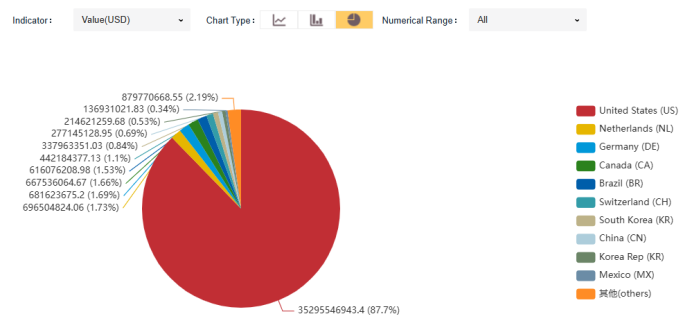
· U.S. Dominance: The U.S. market alone accounts for over 35 billion USD,87.7%
· High-Value Markets: Switzerland and South Korea imports are high-value auto parts
Emerging Markets: Brazil (USD 616M) and China (USD 277M) show growing demand, though volumes remain modest compared to the U.S.
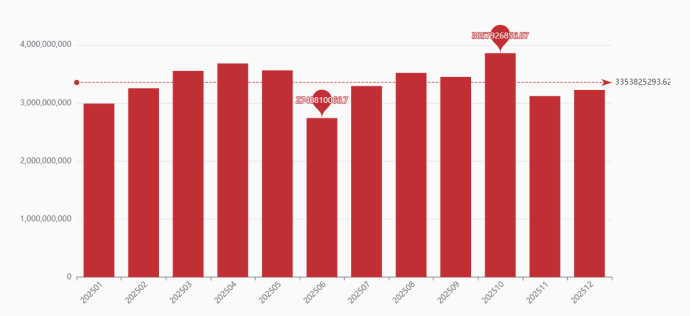
· The export trend shows a clear seasonal pattern with a strong first half, peaking in April ($2.65B) and June ($2.73B). A notable dip occurred in June ($1.97B) compared to the surrounding months, followed by a recovery. The year ended on a relatively lower note in November ($2.22B) and December ($2.38B).
Track key suppliers’ trade data and set alerts for abnormal supply chain shifts.
Match suppliers’ goods to tariff codes and evaluate tariffs’ profit impact on high-value exporters.
Find substitute suppliers and watch non-US markets to offset US tariff risks.
Complete standard USMCA certificates and check qualified regional value content ratios.
Use historical trade data to benchmark and bargain favorable terms with suppliers.
Simulate 10%-25% tariff rates to spot vulnerable auto parts exporters in advance.
The 2025 data clearly shows Mexico's vital role as a manufacturing hub for the North American automotive industry. However, this interdependence is now under threat from aggressive U.S. tariff policies.

 BTD Whatsapp
 BTD Official Account
E-Mail:sales@tradedata.hk